Skip to content

Get on the Brand Wagon

The Women Who Built Cybersecurity Before We Called It Cyber

Posted by TLS Brand Whisperer on Mar 15, 2026 3:45:14 PM

Because the best brands — and the best industries — remember who built the foundation.

March is Women’s History Month, which means social media is currently experiencing its annual surge of: “Celebrating the incredible women in our organization!”

And while that’s nice…it also slightly misses the point.

Cybersecurity didn’t suddenly discover women in 2026.

Women helped invent the field before we even called it cybersecurity. 🎤


The OG Cyber Architects

Before we had threat intelligence feeds, zero-trust frameworks, and vendors promising to “solve cyber with AI,” there were a few people quietly solving the actual problem: making computers work securely.

Among them:

Ada Lovelace 👉 often called the 1st
computer programmer

Ada_Lovelace_daguerreotype_by_Antoine_Claudet_1843_-_cropped

In the 1840s, she wrote what is widely considered the first computer algorithm.

Yes… You read that right...1840s.

Before computers existed.

If cybersecurity is about protecting digital systems, Lovelace helped invent the logic that made those systems possible.

Not a bad start.


Grace Hopper 👉 Computer Scientist &
U.S. Navy Rear Admiral

Grace Hopper

Grace Hopper didn’t just write code. She made it human-readable.

Her work on compilers and COBOL turned computing from something only mathematicians could understand into something organizations could actually use.

Which means every modern security tool, cloud platform, and AI model exists partly because Hopper made software scalable.

Also: she literally coined the term “debugging.”


Joan Clarke 👉 English cryptanalyst who worked as a code-breaker in WWII

Joan Clarke

At Bletchley Park during WWII, Joan Clarke worked alongside Alan Turing, helping crack the Enigma encryption system.

Translation for modern cyber folks:

She helped break one of the most sophisticated cryptographic systems of the time.

Cryptography → encryption → cybersecurity.

Same lineage.

Which brings me to this point: Lineage matters because it reminds us that today’s “new” ideas rarely start from scratch.

Cybersecurity Is Actually a Lineage

The industry loves to talk about innovation. But cybersecurity isn’t really a “new” field.

It’s an evolution of mathematics, cryptography, computing, and engineering built by generations of thinkers.

And many of them were women.

From early programming pioneers to cryptographers to today’s leaders shaping cyber policy, threat intelligence, and AI security.
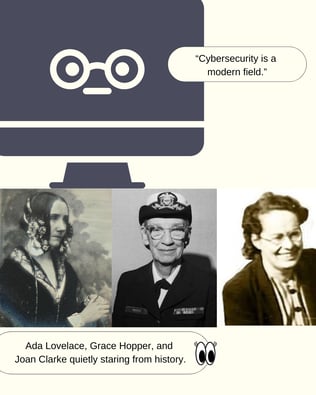
Mar Womens History Month Cyber


The Branding Lesson (Because This Is Still the Brand Wagon)

Here’s where the marketer in me kicks in.

Industries — just like brands — tell stories about themselves. Sometimes those stories get simplified. Sometimes they get rewritten.

And sometimes the real origin story gets buried under buzzwords like:

  • AI-driven security

  • Next-gen cyber defense

  • Autonomous SOCs

  • Quantum-resistant encryption

 But the strongest brands don’t erase their history. They build on it.


Why This Matters Right Now

Cybersecurity is entering another turning point.

AI systems are being deployed everywhere.
Boards are asking new questions about digital risk.
And security leaders are redefining what “defense” even means.

👉 Every major shift in computing — from early programming to cryptography to cloud to AI — was built on the work of people who thought differently about technology.


A Thought for Women’s History Month

Instead of only celebrating women currently in cybersecurity…maybe the better tribute is recognizing that they’ve been shaping it all along.

Not as a trend.
Not as a diversity initiative.

But as architects of the systems we now spend our careers protecting.


Final Thought (Because It’s Sunday)

Cybersecurity didn’t start with a SIEM dashboard.

It started with mathematics, code, and cryptography.

And a surprising number of the people behind those breakthroughs were women.

And if your brand story conveniently forgets who built the foundation…
you might want to check whether your narrative is secure. 😉

Tags: #CyberMarketing, #WomensHistoryMonth

The BOMdotcom (It’s Not What You Think It Is)

Posted by TLS Brand Whisperer on Dec 7, 2025 7:20:27 AM

Sunday Brand Wagon Blog — Cyber Edition

So I’m sitting in a client meeting the other day when someone casually drops the word BOM into the conversation — and suddenly I’m Ben Stiller in Meet the Parents yelling, “What? You can’t say BOM on a plane!!” 😉

Except in cybersecurity, not only can you say it…You must.

Because if there’s one thing this industry loves — besides acronyms, frameworks, and arguing on LinkedIn — it’s a good BOM. 💣


Why BOMs Are the Real Plot Twist in Cyber

If you’ve been anywhere near a SOC, a vendor call, or a “quick alignment meeting” that somehow becomes a two-hour therapy session, you know this truth:

Cyber has no shared language.
Everyone thinks their definition is the definition.

Enter BOM — Bill of Materials.
Except now it comes in flavors:

  • SBOM (Software Bill of Materials)
  • HBOM (Hardware Bill of Materials)
  • AI BOM (because of course)
  • PBOM (Philosophical Bill of Materials — I’m kidding, but honestly, we’re not far off)

We’ve reached BOM-flation.

But beneath the alphabet soup is a real problem:
Every single BOM is a potential source of exploitation if we don’t get aligned on what it means, what goes in it, and who’s responsible for keeping it accurate.


The BOM Problem Nobody Wants to Admit

Repeat after me: An incomplete, outdated, or inconsistent BOM is basically a VIP guest pass for attackers.

If your SBOM is missing open-source components?
If your HBOM doesn’t reflect last month’s supply-chain swap?
If your AI model BOM includes mystery data lineage that “someone will document eventually”?

BOMs are supposed to provide transparency.
Instead, many are becoming Franken-lists stitched together across teams who aren’t speaking the same language.


So, Why Is A Marketer Talking About This?
(HINT: ACTION REQUESTED)

At the risk of stepping out of my lane, I’d like to suggest that we stop treating BOMs like a compliance checkbox and start treating them like the security-critical artifacts they are.

Here’s the Brand Wagon take on a more secure way forward:

1. Pick a BOM Governance Owner (Yes, an Actual Human)

Not “shared responsibility.”
Not “we’ll all pitch in.”

Name a BOM Boss.
Give them authority and a budget.
Give them therapy, if necessary. Because the governance buzzword has its own issues...sorta like a gym membership.
Everyone agrees they should have it, they say they have it, but ask them to show proof and suddenly they’re “between frameworks right now.” But I digress…

2. Standardize the Format — Then Guard It Like the Crown Jewels

If three teams contribute three different BOM formats, congrats, you now have zero usable BOMs.

One format. One source of truth. Repeat after me: ONE.

3. Automate Everything That Humans Will Absolutely Forget

Component tracking? Automate.
Versioning? Automate.
Vulnerability mapping? You guessed it: automate.

Automation is not a dirty word when leveraged correctly.

4. Integrate BOM Data Into Risk Decisions — Not Just Documentation

A BOM is only valuable when it feeds:

  • Threat exposure mapping
  • Supply chain risk quantification
  • Patch prioritization
  • Architecture decisions

If your BOM is living in a lonely SharePoint folder, it’s not a BOM. It’s a scrapbook. Back to that don't treat it like a compliance checkbox.

5. Make BOM Conversations Normal — Not Niche

If the CFO, CEO, and Board don’t know what a BOM is…
Fix that.

If the engineering team thinks an SBOM is “nice to have”…
Fix that.

If marketing thinks BOM is a flight risk word…Okay, honestly, that one’s fair.


Why This Matters for 2026 and Beyond

The future of cyber regulation — and cyber resilience — is moving toward traceability, transparency, and verifiable lineage. BOMs are critical.

Final Thought (and a Little Snark Because It’s Sunday)

Cyber may never align on the perfect framework.
We may never settle the “is it cyber-resilience or cybersecurity” debate.
And someone, somewhere, will always be inventing a new acronym we didn’t ask for.

But BOM?
If we treat it right, BOM might just be the one thing that creates common ground.

Because whether you’re a CISO, a DevOps lead, a risk quant nerd, or a tired marketing whisperer writing a Sunday blog…

💥 A good BOM is truly the BOMB. 💥

#cybermarketing #BOMIsTheBOMB 🎤

P.S. BOM is the BOMB makes my brain also go down the rabbit hole of Bird is the Word. But that's another blog for another Sunday...😆

Tags: #CyberMarketing